CMA CGM has launched its first fully electric barge in Vietnam. The project aims to reduce emissions from inland cargo transportation and support more sustainable logistics.
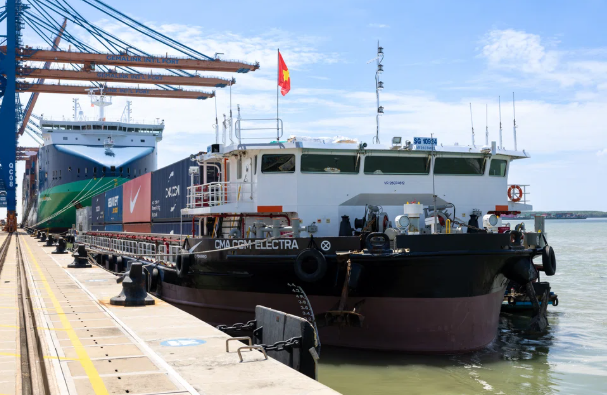
The French shipping company has partnered with Nike and Vietnamese port operator Gemadept. Nike has agreed to use 90% of the barge’s capacity for eight years. This long-term commitment helps support the project’s commercial viability.
The electric barge connects Nike’s inland cargo drop-off location in Ho Chi Minh City with Gemalink deep-sea terminal in Cai Mep. The route covers a 180-kilometre round trip.
Electric Barge Supports Lower-Carbon Logistics
The barge runs on batteries and uses certified renewable electricity from a dedicated solar farm at Gemalink. It produces no direct greenhouse gas emissions during its 180-kilometre journey.
According to the companies, the vessel could prevent around 778 tonnes of carbon dioxide emissions each year. It can also transport more than 50,000 TEUs annually.
The project offers a lower-carbon alternative to road transport for inland cargo. It also combines electric transportation, charging facilities and renewable energy in one logistics solution.
Nike’s Cargo Commitment Supports the Project
Nike will serve as the project’s anchor customer. Under an eight-year agreement, the footwear company has committed to filling 90% of the barge’s capacity.
This commitment is important because the electric vessel costs about twice as much as a comparable diesel-powered barge. CMA CGM says the project’s business case depends on several factors.
These include charging infrastructure, renewable energy supply, operating costs and efficient cargo handling. Long-term customer commitments also play a key role.
Nike began manufacturing in Vietnam in 1995. The country has since become its largest footwear production base worldwide. In fiscal year 2026, Vietnam accounted for about 52% of Nike-branded footwear production and 34% of its apparel production globally.
Vietnam Offers Strong Potential for Electric Inland Transport
Vietnam is an important manufacturing and logistics centre in Southeast Asia. Its extensive inland waterways connect production areas with major deep-sea ports.
CMA CGM believes these waterways create opportunities for more sustainable cargo transportation. The company has operated in Vietnam since 2006. It currently runs 29 weekly mainline services that call at seven ports across the country.
The electric barge was designed and developed by CMA CGM and built at a shipyard in China. It uses battery technology supplied by Chinese manufacturer CATL.
The vessel has an operating range of 180 kilometres. It takes about four hours to recharge its batteries. Alternatively, workers can replace the batteries in around 30 minutes during container loading or unloading.
CMA CGM Explores Further Electric Barge Projects
CMA CGM is studying whether it can adapt the electric barge model for other customers and markets. The company is also considering inland waterway networks in Europe.
Potential locations include northern France, the Benelux region along the Rhine, and the Seine and Rhône rivers.
However, CMA CGM has not confirmed any investment plans or deployment dates. Future projects will depend on operational performance, local infrastructure and suitable partnerships.
The Vietnam project could serve as a model for other markets. It demonstrates how shipping companies, customers and port operators can work together to develop lower-carbon logistics solutions.
A Step Towards Sustainable Freight Transportation
CMA CGM’s electric barge initiative highlights the growing role of inland waterways in sustainable freight transportation. By combining electric power with renewable energy, the project aims to reduce emissions while moving cargo efficiently.
As companies continue to seek ways to lower supply chain emissions, partnerships and long-term cargo commitments may help make cleaner transport solutions commercially viable.
The project could also encourage further investment in electric inland transport across Vietnam and other regions.