Finalized Deal Centers on Section 232 Tariffs Under January Taiwan Framework Agreement
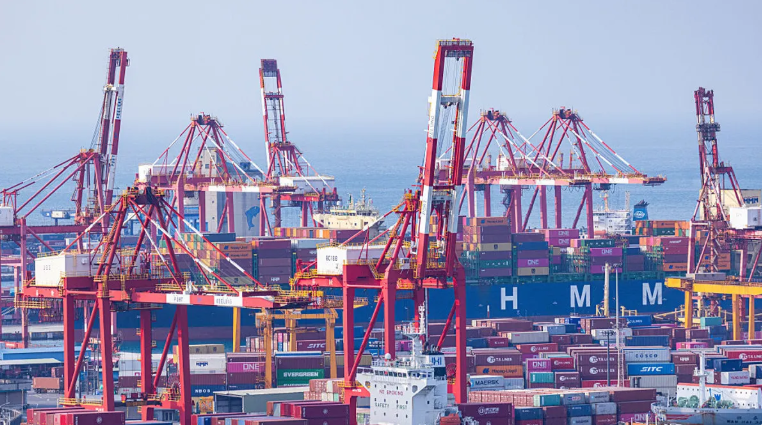
Containers are pictured at the Port of Keelung in Taiwan on April 4, 2025. The latest agreement applies to selected Taiwanese auto parts, timber, lumber and related wood products, as well as certain aircraft components containing steel, aluminum or copper.
(Annabelle Chih via Getty Images)
The United States and Taiwan have finalized a trade and investment agreement that limits Section 232 tariffs on designated Taiwanese imports to a maximum of 15%, according to the U.S. Commerce Department.
Under the agreement, the U.S. will cap Section 232 tariffs at 15% on selected Taiwanese automobile parts, timber, lumber, related wood products, and certain aircraft components containing steel, aluminum, or copper. The revised tariff measures take effect retroactively from May 1.
The deal focuses exclusively on Section 232 tariffs, consistent with the framework agreement reached between the two sides in January. That earlier framework also included provisions for zero reciprocal tariffs on generic pharmaceuticals, pharmaceutical ingredients, and certain unavailable natural resources, although those items are not addressed in the May 28 agreement.
According to Greg Husisian, partner and chair of the International Trade and National Security Practice at Foley & Lardner, the latest agreement reflects the U.S. administration’s response to a Supreme Court ruling in February that struck down country-specific tariffs imposed by President Donald Trump in 2025. At the time of the January framework agreement, Taiwanese goods were subject to a 20% reciprocal tariff.
“The administration has since relied on other trade mechanisms, including Section 232 and Section 301, to maintain tariff pressure,” Husisian said. “The latest adjustments for Taiwan refine those measures while maintaining the agreed 15% tariff ceiling.”
For qualifying passenger vehicles and light trucks, the tariff cap applies to covered auto parts. Imports already subject to a tariff rate of 15% or higher will not face any additional Section 232 duties. Where the existing tariff rate is below 15%, a Section 232 surcharge will be added to bring the total rate up to the 15% threshold.
The agreement also removes additional Section 232 derivative tariffs on steel, aluminum, and copper for certain non-military aircraft components imported from Taiwan. According to digital freight forwarder Flexport, the affected products include a wide range of equipment used in aircraft manufacturing, such as hydraulic systems, compressors, heat exchangers, transformers, and electrical apparatus.
According to the Commerce Department, the 15% tariff on covered wood products serves as a minimum rate, even for imports that would otherwise qualify for reduced or zero duties under free trade agreements or preferential trade programs. As a result, importers cannot use these programs to lower the tariff below the 15% threshold.
The document also notes that existing trade measures, including antidumping and countervailing duties, will continue to apply in addition to the 15% tariff.
On Taiwan’s side, the agreement includes commitments to support and streamline U.S. investment in key sectors such as semiconductors, artificial intelligence, defense technology, telecommunications, and biotechnology. In return, Taiwanese semiconductor and technology companies are expected to invest $250 billion in the United States, focusing on advanced semiconductor manufacturing, energy projects, and AI-related production.