SINGAPORE – Singapore and China have agreed to collaborate on decarbonising and digitalising shipping routes between the two countries through the establishment of a national green and digital shipping corridor.
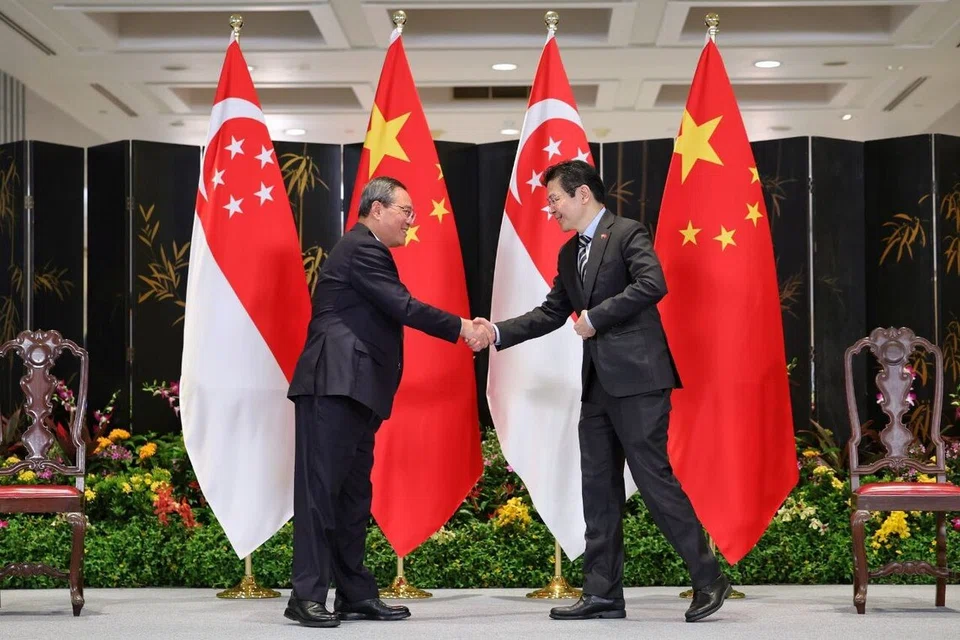
The memorandum of understanding (MOU) is one of eight agreements exchanged on Oct 25 during an official visit by Chinese Premier Li Qiang, as both nations pledged to further strengthen cooperation and deepen bilateral relations.
Premier Li, visiting Singapore for the first time in his current capacity at the invitation of Prime Minister Lawrence Wong, was welcomed by a guard of honour at Parliament House.
During bilateral discussions, PM Wong emphasised the importance of deepening cooperation and upholding the principles of free trade.
“We would like to see how we can deepen our cooperation further, and also how we can work together to uphold the key principles of free trade and the rules-based multilateral order,” he said.
Mr Li, the first Chinese Premier to visit Singapore in seven years, said he looked forward to enhancing China-Singapore ties during his visit, and reaffirmed China’s readiness to work closely with Singapore to support the modernisation of both countries and contribute to peace and stability in the region.
In a statement upon his arrival, Mr Li noted that relations between the two countries continue to grow steadily, pointing to the upgrade of bilateral ties in 2023 to an “all-round high-quality future-oriented partnership.” He also highlighted the strategic plans outlined by PM Wong and Chinese President Xi Jinping during their meeting in June 2025 to further advance cooperation.
PM Wong expressed confidence in China’s long-term economic trajectory and development prospects. Singapore’s Ministry of Foreign Affairs (MFA) said both leaders also exchanged views on regional and international developments.
PM Wong voiced Singapore’s support for China’s Global Development Initiative (GDI) and reaffirmed the Republic’s readiness to work with countries in Beijing’s GDI “Group of Friends.” Introduced by President Xi in 2021, the initiative seeks to help developing nations achieve the United Nations 2030 Sustainable Development Goals, with a focus on areas such as climate action, food security, and sustainable growth.
Both leaders also discussed cross-strait issues, with PM Wong reiterating Singapore’s consistent “One China” policy and its opposition to Taiwan independence.
Strengthening Maritime Sustainability and Digital Connectivity
The new national shipping corridor represents an expansion of existing collaborations between Singapore and Chinese provinces such as Tianjin and Shandong, which currently serve as testbeds for digital solutions and low-emission fuels along trade routes.
Under the Singapore–Tianjin corridor, both sides have commenced joint research on the use of green methanol, a lower-emissions fuel alternative for ships. Meanwhile, the Singapore–Shandong corridor focuses on improving digital information exchange to facilitate faster port clearance processes.
Tianjin is home to the largest port in northern China, while Shandong—China’s second most populous province—hosts one of the world’s busiest container ports in Qingdao.
The latest agreement adds to Singapore’s growing network of green and digital shipping corridors, now numbering seven. In addition to partnerships with Tianjin and Shandong, Singapore has similar initiatives with the ports of Los Angeles and Long Beach in the United States, as well as Rotterdam in the Netherlands. At the national level, Singapore also maintains such corridors with Japan, Australia, and, most recently, India.
Since 2013, China has been Singapore’s largest trading partner, with total bilateral trade reaching $170 billion in 2024, a 1.8 per cent increase from the previous year. Six of the world’s ten busiest container ports are located in mainland China.
Expanding Cooperation Across Multiple Sectors
Other MOUs signed during Premier Li’s visit include an agreement to jointly develop a training programme for government officials from the ten ASEAN member states and Timor-Leste, soon to become the bloc’s 11th member.
The programme, first proposed during PM Wong’s visit to China in June 2025, will focus on clean energy transition, sustainable urban development, and climate resilience, and will support initiatives such as the ASEAN Power Grid. The grid has gained momentum in recent years, including plans for a new subsea electricity cable linking Indonesia and Singapore and a US$10 billion (S$13 billion) funding initiative to accelerate development.
Another MOU will strengthen cooperation on emergency management, including firefighting, rescue operations, and disaster response.
Both sides also renewed and updated existing agreements on food safety and information and communications technology, while committing to enhance collaboration in green development and the digital economy.
The new agreements aim to promote business opportunities in emerging sectors such as carbon trading, carbon capture, and low-carbon hydrogen, as well as encourage digital trade and the exchange of best practices in digital regulation and policy.
A final MOU signed on Oct 25 will expand the functions of the Singapore Launchpad, which facilitates two-way investment between Singapore and the Suzhou Industrial Park. Under this agreement, both countries will support the creation of business cooperation centres across Southeast Asia to position Singapore as a gateway for regional trade and investment flows between China and ASEAN.
Strengthening Diplomatic and Economic Ties
Premier Li’s two-day visit marks the 35th anniversary of diplomatic relations between Singapore and China. After their meeting at Parliament House, PM Wong hosted an official dinner in honour of Premier Li at Gardens by the Bay, where both leaders exchanged toasts to commemorate the occasion.
On Oct 26, Mr Li will call on Acting President Eddie Teo, chairman of the Council of Presidential Advisers, as President Tharman Shanmugaratnam is currently overseas on leave.
The Premier will also meet with business leaders from both countries at the Singapore–China Business Roundtable, hosted by Deputy Prime Minister Gan Kim Yong, before departing for Malaysia to attend the 47th ASEAN Summit in Kuala Lumpur.