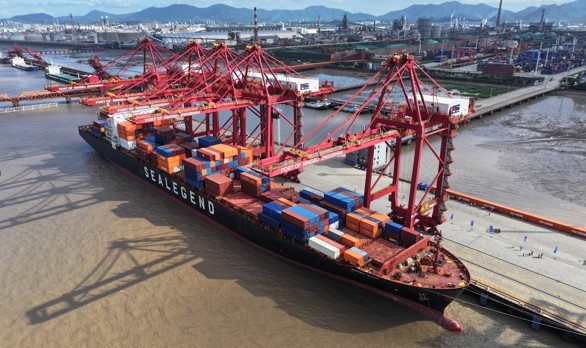
China has officially launched the world’s first scheduled container shipping service between China and Europe via the Arctic — the China-Europe Arctic Express route. This new route utilizes the Northern Sea Route (NSR) and shortens the transit time to Europe to just 18 days.
The Istanbul Bridge container vessel departed from Ningbo-Zhoushan Port on September 22, and will link key Chinese ports — including Ningbo, Shanghai, Qingdao, and Dalian — with major European destinations such as Felixstowe (UK), Rotterdam (Netherlands), Hamburg (Germany), and Gdansk (Poland).
Designed to support cross-border e-commerce and the transport of high-value goods, the route is a major milestone in China’s Belt and Road Initiative, particularly in advancing the “Polar Silk Road” concept. It offers a faster, more efficient option for shipping products like building materials, textiles, and electromechanical equipment to European markets.
According to state media, Xiao Bin of China Ocean Shipping Agency Fuzhou Co., Ltd. stated that the Arctic route is approximately one week faster than the China-Europe rail service, and more than 20 days quicker than traditional sea routes through the Suez Canal or around the Cape of Good Hope.
The launch is well-timed with Europe’s peak pre-Christmas shipping season, offering exporters faster market access and helping to avoid delays during the busiest time of the year.
The European Union continues to be Ningbo Port’s largest trading partner, with bilateral trade reaching 330.74 billion yuan (around US$46.5 billion) in the first eight months of the year — a 12% increase compared to the same period in 2024. This accounts for about 18% of the port’s total foreign trade, according to Ningbo Customs.
The China-Europe Arctic Express is now the fastest container shipping route between China and Europe, reducing transit time by 22 days and cutting one-way carbon emissions by half compared to traditional maritime routes.
However, despite its speed and efficiency, the use of the Northern Sea Route has sparked concerns over environmental risks to the fragile Arctic ecosystem and the limited infrastructure available to support ships in emergencies.